Best Battery Chargers for Boat Trolling Motors: Top Picks for Clean Power on the Water
Answering the buyer’s search for a reliable trolling motor battery charger, the following picks are designed for marine use, corrosion resistance, and multi-battery capability. They suit anglers needing quick, safe charges, boat owners maintaining deep-cycle packs, and late-season users seeking smart maintenance. The top five choices cover multiple banks, compatibility with lead-acid and LiFePO4 batteries, and temperature-compensated charging to protect battery life. The table below helps compare core options at a glance.
| Product | Best For | Key Benefit |
|---|---|---|
| NOCO Genius GEN5X2 | Two-battery boats and MV setups | 5 A per bank, multi-mode charging |
| NOCO Genius GEN5X1 | Compact, single-bank systems | 5 A, compact high-power onboard charger |
| Minn Kota 1823155 MK 315D | Digital, automatic boat charging | Digital control with temperature compensation |
| 2 Bank Marine Battery Charger 5X2 FirstPower Pro | Two-bank, waterproof onboard charging | IP68 waterproof, independent bank modes |
| NEXPEAK NC201 | Multi-vehicle and marine setups | 10 A total with 24 V options, mode flexibility |
In the following sections, each product is explained with its ideal buyer, why it’s a good fit, and any practical limitation to consider. The goal is to help you choose a charger that matches your boat’s battery type, charging needs, and environmental conditions.
NOCO Genius GEN5X2: Dual Bank Onboard Charger
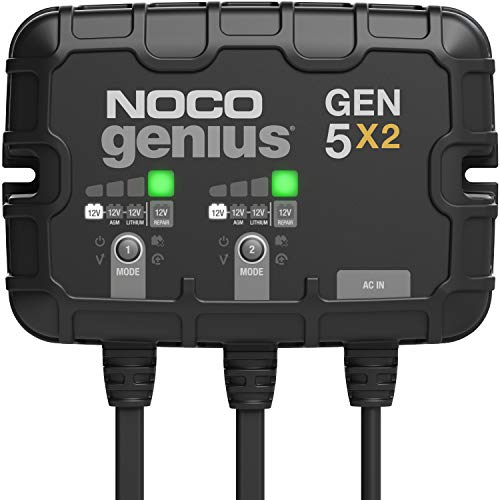
The GEN5X2 provides two independent charging banks at a total of 10 amps (5 A per bank), designed for boats with more than one battery or separate marine systems. It supports 12V, AGM, and Lithium charging modes, plus a Repair mode to address discharged or aged batteries. This unit is best for boat owners who need reliable, simultaneous charging for multiple 12V batteries in harsh marine conditions. Caution: If your batteries require significantly uneven charging, ensure both banks are programmed to their appropriate mode for each battery to avoid one bank undercharging.
Best for: Two-battery systems on mid- to large-size saltwater or freshwater boats. Why selected: Independent banks offer flexibility without sacrificing space or performance. Limitation: Moderate installation footprint; ensure your cockpit or bilge area has ventilation and waterproofing alignment.
NOCO Genius GEN5X1: One-Bank Onboard Charger
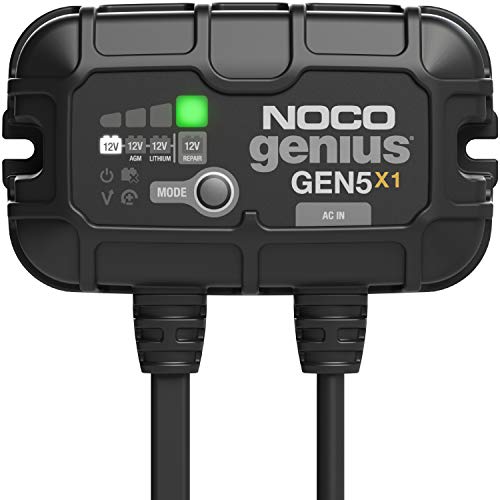
The GEN5X1 delivers a compact, single-bank 5-amp onboard charging solution. It’s ideal for boats with a single 12V battery or a dedicated deep-cycle/starting battery pairing. Modes cover 12V, AGM, Lithium, and a Repair option, enabling precise maintenance and compatibility with a range of battery chemistries. Caution: For boats running multiple critical electronics on separate circuits, a second bank may be necessary to prevent cross-load issues.
Best for: Small boats or anglers with a single 12V power pack. Why selected: Compact design makes it easier to fit in tight compartments. Limitation: Only one bank means no simultaneous charging of a second battery without an additional charger.
NOCO GENIUS1: Smart Battery Charger and Maintainer

The GENIUS1 is a versatile 1A/1V-6V to 12V smart charger with trickle maintenance and a desulfator. It supports lead-acid and Li-ion batteries, including marine and deep-cycle variants, with an integrated thermal sensor to adjust charging in response to ambient temperature. This unit is best for owners who want a maintenance charger that can also revive older batteries through desulfation. Caution: It delivers lower charging current, so longer charging cycles may be required for large deep-cycle packs.
Best for: Spare charging or onboard maintenance for smaller boats and stored batteries. Why selected: Thermal compensation and desulfation provide long-term battery health. Limitation: Low current means slower charge recovery for large capacity packs.
Minn Kota 1823155 MK 315D Digital On-Board Charger

The MK 315D is a three-bank charger delivering five amps per bank, with digital control for faster, more accurate charging. It includes LED indicators that show charge stage, maintenance mode, and errors. Best for boats with multiple batteries needing coordinated management, especially when you rely on electronics across several circuits. Caution: Some users may require additional space for three-bank installation, depending on hull layout.
Best for: Boats with three batteries needing coordinated charging. Why selected: Digital control and clear indicators improve reliability and troubleshooting. Limitation: Larger form factor may constrain installation in tight compartments.
FirstPower Pro 2 Bank Marine Battery Charger 5X2

The 5X2 model provides two banks at 5A per bank with IP68 waterproof protection. It supports 12V SLA/AGM, 12V Lithium, and 12V Calcium, with independent mode selection for each battery. This charger is ideal for 24/7 onboard charging in wet environments and for boats with diverse battery chemistries. Caution: Ensure mounting location remains accessible for mode changes and monitoring; waterproofing helps, but ventilation remains important.
Best for: Two-bank, all-weather charging for mixed battery chemistries on small to mid-sized boats. Why selected: Waterproof design and independent bank control offer robust reliability. Limitation: Some users may require separate maintenance for very old or highly sulfated batteries.
Buying Guide: Choosing The Right Boat Trolling Motor Charger
What should I consider before buying?
- Battery types and chemistry: Lead-acid, AGM, Gel, and LiFePO4 each require specific charging profiles. Look for chargers with selectable modes for multiple chemistries.
- Bank count and capacity: Two-bank or three-bank units are useful for boats with multiple batteries. Ensure per-bank amperage matches battery size and depth of discharge goals.
- Waterproof and rugged build: Marine environments demand IP-rated or fully waterproof housings and corrosion-resistant terminals.
- Temperature compensation: Chargers with thermal sensing prevent overcharging in heat and undercharging in cold, extending battery life.
- Maintenance and desulfation features: Desulfation and trickle maintenance help preserve performance for older packs or infrequently used boats.
- Installation space and wiring: Verify available space under console or bilge, and confirm that mounting points and cable runs accommodate your boat layout without strain.
How do I choose between two-bank vs. three-bank options?
Two-bank configurations suit boats with a pair of critical batteries or a starting/house split. Three-bank units are useful for boats with three or more batteries or when you want dedicated charging for electronics, trolling motor, and starter packs separately. Consider your current battery count, anticipated expansion, and whether you need independent charging modes per bank.
Are smart chargers worth it for marine use?
Yes, smart chargers offer temperature compensation, multi-mode charging, and maintenance cycles that help prolong battery life in varied marine conditions. They’re especially advantageous for boats stored outdoors or used seasonally, where batteries may sit idle for long periods.
FAQ
- Q: Can I use a car battery charger on a boat trolling motor battery? A: It depends on the charger’s voltage and current; choose marine-rated chargers designed for 12V systems with appropriate IP ratings.
- Q: Do these chargers support LiFePO4 batteries? A: Several models offer 12V Lithium modes; confirm lithium compatibility in the product specifications.
- Q: Is permanent mounting required for onboard chargers? A: Not always, but many marine chargers are designed for in-vehicle mounting to ensure consistent charging and easy access.
- Q: What is a repair mode? A: A mode that helps revive slightly discharged or sulfated batteries by applying targeted charging strategies.
- Q: Should I disconnect batteries during charging? A: Generally not necessary for onboard chargers, but follow the manufacturer’s installation and safety guidelines.
- Q: Do these chargers automatically switch to float/maintenance mode? A: Many do, helping prevent overcharging when batteries reach full capacity.