Best Battery Options for Boat Lifts on the Water
Choosing a reliable battery for a boat lift requires considering weight, longevity, charging versatility, and safety in marine conditions. The following 5 batteries from trusted brands offer robust LiFePO4 and AGM options suitable for powering boat lifts, trolling motors, and other marina equipment. Each product is evaluated for cycle life, protection features, and suitability for marine use to help you pick a durable, maintenance-free solution.
| Product | Brand | Type | Key Benefit |
|---|---|---|---|
| 100Ah LiFePO4 Battery 12.8V | HRBEENERGY | LiFePO4 | High current capability, 100A BMS |
| Newport 12V50Ah Deep Cycle AGM | Newport Vessels | Sealed AGM Lead Acid | Lightweight, leak-proof for marine use |
| Lifepo4 Battery 100Ah 24V | Elefast | LiFePO4 | Dual 24V system with strong inrush handling |
| Lampword 12V Lifepo4 Battery 15Ah | Lampword | LiFePO4 | Compact backup power with high cycle life |
| NERMAK 12V 10Ah LiFePO4 | NERMAK | LiFePO4 | Low-weight, durable for small setups |
HRBEENERGY 100Ah LiFePO4 Battery for Marine Use

The HRBEENERGY 100Ah LiFePO4 battery is designed for demanding marine applications, including boat lifts and trolling motors. It features a 100A BMS that protects against overcharge, over-discharge, over-current, overheating, and short circuits, plus a low-temperature cut-off to guard performance in cold conditions. With a high discharge capability, it supports fast discharges up to 100A and a 200A inrush for quick motor starts. The battery’s 12.8V nominal rating and 1280Wh capacity deliver substantial energy density at a lighter weight compared to lead-acid alternatives, making installation on vessels easier and safer. The compact form factor and long cycle life (8000+ deep cycles expected) make it suitable for repeated lift cycles and battery maintenance intervals.
Key considerations for this model include its optimization for marine environments and compatibility with typical 14.6V charging schemes, along with recommended charging currents under 50A to maximize lifespan. It serves as a solid upgrade from traditional lead-acid or AGM packs, delivering greater energy density and a substantially lower weight (about 19.4 lbs). While it excels for high-drain needs, users should verify fitment with their lift controller and any required battery management accessories.
Newport 12V50Ah Deep Cycle AGM Marine Battery

This Newport Vessels 12V50Ah deep cycle AGM battery is engineered for marine reliability and ease of use. Its sealed construction helps prevent leaks and corrosion in damp, salt-rich environments, a common concern around boat lifts and other on-water equipment. The battery is designed with trolling motor compatibility in mind, delivering dependable, steady power for lift controls or auxiliary accessories. At approximately 32 pounds, it strikes a balance between handling and performance, offering robust discharge characteristics while remaining manageable for vessel crews to install or replace. This option is particularly appealing for systems that favor traditional sealed lead-acid chemistry with modern AGM advantages and straightforward maintenance.
Pros include proven durability, leak-free design, and a ready-to-use drop-in replacement for many standard marine setups. Potential drawbacks to consider are weight compared with higher-energy LiFePO4 options and the need for compatible charging profiles to maximize cycle life and performance in marine applications.
Litime 12V 100Ah Trolling Motor LiFePO4 Battery
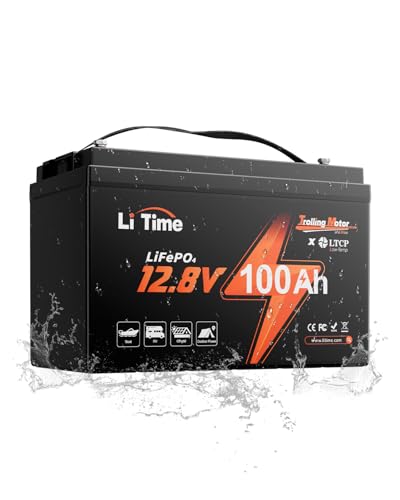
The Lifepo4 Battery from Lithe owner Lifepo4 family is built for marine reliability with a built-in 100A BMS that provides triple protection against dust, water, and salt spray, plus safeguards against overcharge and short circuits. It is designed for trolling motors and other high-demand marine loads, including boat lifts. The battery supports low-temperature protection, stopping charging below 32°F and discharging below -4°F, which helps protect the chemistry in cold climates. With a high discharge readiness and protection features, it maintains performance during rough waves or heavy lift operations. The built-in TVS diode helps shield voltage spikes when used with variable loads.
Consider this option if you need a 24V system or plan to pair multiple batteries for higher power. The design emphasizes surge tolerance and rapid recovery from overload, reducing downtime during lift cycles or motor starts. Ensure the battery voltage and BMS configuration aligns with your lift controller and charging system to maximize lifespan and performance.
Lampword 12V Lifepo4 15Ah Marine Battery

The Lampword 12V 15Ah LiFePO4 battery is a compact power option ideal for backup power on small marine setups or to supplement existing systems powering boat lifts during maintenance windows. It provides a 12V output with 192Wh capacity, making it suitable for low-draw electronics, lighting, sensors, and small accessories. Features include a built-in 15A BMS, a lightweight form factor (roughly 3.2 pounds) and a charging profile designed for LiFePO4 chemistry with a recommended 3A charging rate. The battery supports 100% DoD for extended cycle life and allows easy stacking or parallel configurations to increase voltage or capacity as needed.
Best uses are compact auxiliary power, emergency backup, or as part of a modular marine energy system. This model may not be ideal for high-load lift operations on its own, but it pairs well with larger packs or as a supplemental source in multi-battery configurations. Always verify compatibility with your lift controller and overall power budget.
NERMAK 12V 10Ah LiFePO4 Battery

The NERMAK 12V 10Ah LiFePO4 battery is a compact option with a built-in 10A BMS and typical LiFePO4 safety features to prevent overcharge, over-discharge, and short circuits. It is positioned for light-duty marine tasks, solar back-up, or as a small, reliable power source for auxiliary devices on a boat. The product emphasizes a long cycle life, low self-discharge, and robust safety features, making it suitable for small-scale lift controls, lighting, and sensor systems where space and weight are critical. However, it may not meet higher current demands or heavy lift cycles that require larger capacity or higher continuous discharge ratings.
Use this battery as part of a modular power setup or for backup applications, noting its best-fit for low to moderate current draws rather than sustained high-power lift operations. Confirm your layout’s voltage and BMS coordination with your equipment before integration.
Buying Guide: Key Factors For Boat Lift Battery Selection
- Voltage and capacity: For boat lifts, consider higher energy density and sufficient capacity to handle repetitive lift cycles. LiFePO4 options tend to provide longer lifespans and deeper discharge capabilities than traditional AGM or lead-acid batteries.
- Discharge current and BMS protections: A robust BMS with overcharge, over-discharge, over-current, and short-circuit protection is essential, especially in marine environments with variable loads. Inrush power for motor Starts is a critical consideration.
- Weight and space: LiFePO4 packs are significantly lighter than lead-acid equivalents while delivering similar or higher energy. Check the dimensions to ensure a secure fit on the boat or trailer.
- Cold weather performance: Low-temperature cut-off and protection ensure safe operation in cool coastal climates. Batteries designed for low-temperature environments help preserve performance and lifespan.
- Charging compatibility: Verify that your charging system (solar, shore power, or alternator) matches the battery’s recommended charging voltage and current. Some systems benefit from a higher charge current if the BMS supports it.
- Maintenance and longevity: LiFePO4 chemistry typically requires minimal maintenance and offers thousands of cycles. AGM is less maintenance-intensive than flooded lead-acid but generally has shorter cycle life than LiFePO4.
- System integration: If you plan to run multiple batteries in series or parallel, ensure your BMS and wiring are designed for such configurations and that the lift controller can utilize the available voltage and current.
- Safety and durability: Look for marine-grade enclosures, corrosion resistance, and sealed designs to prevent leaks and sulfation. UV resistance and vibration tolerance are also beneficial for boat installations.