Best Jet Motor for Boat: Top 5 Outboard Options for Different Boating Needs
Answering the search intent for this topic, these jet motor options cover a range of small to mid-size boats with emphasis on reliability, ease of use, and fuel efficiency. Ideal buyers include casual lake cruisers, inflatable dinghy operators, small fishing boats, and light-watercraft enthusiasts who want responsive control and straightforward maintenance. The following picks balance power, portability, and practical features like 360° rotation, CDI ignition, and wind cooling where applicable.
| Product | Best For | Key Benefit |
|---|---|---|
| JDCEREN 4HP 55CC Outboard | Rubber and wooden boats needing compact power | Strong power, 360° rotation, CDI ignition |
| MOCHAG 4HP 55CC Outboard | Durable, step-less speed control | Premium materials and adjustable speed |
| Pxolerig 4HP 55CC Jet Pump | Environment-conscious uso and flexible control | Fuel-saving four-stroke with reverse gear option |
| JDCEREN 1000W Electric Jet Pump | Inflatable or light boats; no gasoline | Brushless efficiency and omni-directional control |
| LTIGOAW 4HP 55CC Jet Pump | Small boats under 4m and 500kg | Wind cooling and robust maximum thrust |
JDCEREN 4HP 55CC Outboard Motor
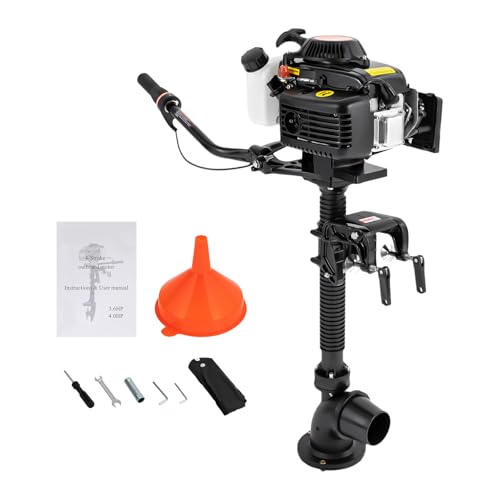
The JDCEREN motor provides 4.0hp, 55cc, with a 2900W output and 4500-5500rpm. It uses a CDI ignition system, a tilt function, and a 360-degree rotation to simplify maneuvering, including reverse rotation by 180 degrees. Best for small rubber or wooden boats that require reliable, straightforward jet propulsion with quick-start capability. Caution: 4-stroke engines need regular fuel and oil mixing per manufacturer guidance; verify compatibility with your boat’s transom mounting.
MOCHAG 4HP Outboard Motor

The MOCHAG model features 4 HP from a 55cc 4-stroke engine with 2900W power and 4500-5500rpm. It emphasizes a step-less speed change function for smooth throttle control and a 360-degree rotatable head with CDI ignition. Best for boaters who prioritize adaptive speed control and fuel efficiency over pure top-end speed. Limitation: heavier construction may affect portability on very small craft.
Pxolerig 4HP 55CC Jet Pump
The Pxolerig jet motor uses a 4hp, 55cc 4-stroke engine delivering 2900W and 4500-5500rpm. It promotes fuel efficiency by using a four-stroke engine and offers a step-less speed change, tilt function, 360-degree rotation, and reverse capability via 180-degree head rotation. Best for eco-conscious users who want precise throttle control. Caution: ensure the jet drive design suits your boat length and weight to maintain stability at higher speeds.
JDCEREN Outboard 1000W Electric Jet Pump

This electric option outputs 1000W with a brushless design for higher efficiency and lower maintenance compared to brushed motors. It incorporates a rotatable stand and omnidirectional joystick for flexible operation. Best for inflatable, iron, or plastic boats that require quiet operation and simple wiring. Limitation: electric jets may demand a stable power source and careful water-cooling considerations for prolonged use.
LTIGOAW 4-Stroke Jet Pump Outboard

The LTIGOAW outboard motor delivers 4.0 HP from a 55cc engine with up to 4500-5500rpm and a maximum thrust sufficient for small craft up to about 4 meters and 500 kg. It includes wind cooling, CDI ignition, and manual start. Best for boaters who want robust thrust and reliable performance in light-to-medium loads. Caution: check fuel compatibility and ensure the tank capacity aligns with planned trips to avoid frequent refuels.
Buying Guide
Key factors when choosing a jet motor for a boat:
- Boat compatibility: Match horsepower (HP) and displacement (cc) to your boat’s size and weight.
- Fuel vs. electric: Gas-powered models offer portability on the water; electric options reduce emissions and require a power source or battery setup.
- Thrust and rpm: Higher rpm typically means stronger thrust; ensure your transom and mounting hardware support the chosen motor.
- Controls: Look for 360-degree rotation, tilt capability, and CDI ignition for easier steering and reverse maneuvers.
- Durability: Materials like aluminum alloys, nylon, and corrosion-resistant components extend life in saltwater or freshwater.
- Ease of maintenance: Four-stroke designs generally provide better fuel efficiency and cleaner operation than two-stroke engines.
Frequently Asked Questions
- What is a jet motor in a boat? A jet motor uses a jet drive to propel the boat, often providing good maneuverability and shallow-water performance.
- What should I consider when selecting a jet motor for an inflatable boat? Focus on weight, mounting compatibility, thrust, and fuel availability for your typical trips.
- Are four-stroke jet motors more fuel-efficient than two-stroke models? Generally yes, due to better combustion efficiency and lower emissions.
- Is an electric jet pump suitable for all boats? Electric models are ideal for lighter craft and quiet operation but require access to a power source or battery setup.
- How important is the wind cooling feature? Wind cooling helps maintain engine temperature during extended use, reducing the risk of overheating.
- Do these motors require professional installation? Installation difficulty varies; consult mounting compatibility and ensure secure transom attachment.