Best Lithium Batteries for Boats for Reliable Marine Power
Choosing the right lithium battery for a boat can improve reliability, reduce weight, and extend off‑grid capabilities. The following selections emphasize LiFePO4 technology with strong BMS protection, deep cycle performance, and marine‑grade durability. Each option is designed to handle trolling motors, onboard electronics, and solar charging with safety and efficiency in mind. The list below highlights five top picks that balance cycle life, safety features, and practical capacity for American boaters.
| Product | Brand | Capacity | Key Benefit |
|---|---|---|---|
| 100Ah LiFePO4 Battery 12.8V | HRBEENERGY | 100Ah | High current, low-temp protection, compact weight |
| Litime 12V 100Ah Bluetooth Battery | Litime | 100Ah | Smart monitoring, IP65, 15000 cycles |
| 12V 100Ah Group 24 Battery | VATTER POWER | 100Ah | Expandable system, upgraded 100A BMS |
| MOSEWORTH 12V 100Ah Battery | MOSEWORTH | 100Ah | Low-temp protection, fast charging potential |
| DJLBERMPW 12V 100Ah Battery | DJLBERMPW | 100Ah | UL1973‑certified cells, 15000 cycles |
HRBEENERGY 100Ah LiFePO4 Battery

The HRBEENERGY 100Ah LiFePO4 battery is designed with a built‑in 100A BMS and supports 8000+ deep cycles. It emphasizes fast charging and discharging, with a recommended charging voltage of 14.6V and a 50A charging current. The 200A inrush capability within seconds supports sudden power draws, such as motor startup, while maintaining protection for over‑charge, over‑discharge, and overheating. Its lightweight design (~19.4 lbs) offers a strong energy density advantage over traditional lead‑acid units, making it a practical choice for compact boat layouts.
Key features include: a robust 100A BMS, low‑temperature cutoff for safe operation in cool mornings on the water, and a maintenance‑free life cycle. The battery is a solid lead‑acid replacement with smaller footprint and higher energy density, suitable for trolling motors, marine electronics, and solar storage on deck or in compartments.
Litime Bluetooth 12V 100Ah Battery

This Limite model features smart Bluetooth monitoring that auto‑connects in seconds, enabling battery status checks, discharge control, and system checks from a mobile device. It includes low‑temperature protection to avoid damage in cold conditions and a suite of safety protections against overcharge and short circuits. The IP65 water and dust resistance makes it suitable for marine environments, with the added benefit of easy remote management for boats with solar charging or limited access to shore power.
Litime 12V 100Ah Battery (Group 31)
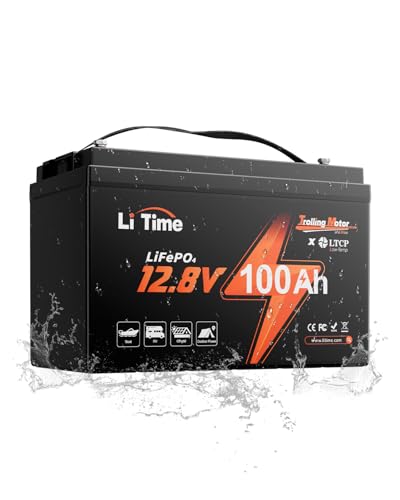
This Limite model prioritizes safety with extra BMS protections including dust, water, and salt spray safeguards, making it well suited for marine use. It provides smart low‑temp protection that cuts off charging below 32°F and discharging below -4°F, helping extend lifespan in chilly waters. A built‑in TVS shield protects trolling motors from voltage spikes, delivering stability in rough seas for marine, RV, and storage applications.
VATRER POWER 12V 100Ah Group 24 Battery

VATTER POWER offers a scalable 12V 100Ah Group 24 unit with an upgraded 100A BMS and grade A cells. It includes both high and low temperature cutoffs and auto‑balancing, ensuring safe operation across a wide temperature range. The design supports up to 16 identical units wired 4P4S to scale from 1.28 kWh to 20.48 kWh, making it a practical choice for expanding a marine power system as needs grow, from basic trolling motor setups to larger onboard energy storage.
DJLBERMPW 12V 100Ah Battery

DJLBERMPW emphasizes UL1973 testing and a 100A BMS with low‑temperature cut‑off. It supports up to 15000 deep cycles and a 10‑year lifespan under proper use. The battery is designed to handle 100A continuous discharge with a 200A inrush, and recommends a 14.6V charging voltage with up to 50A charging current. The model balances high cycle life with practical marine compatibility, aiming to deliver reliable power for trolling motors, solar, and onboard systems.
Buying Guide: Key Purchase Considerations
Battery confidence on a boat comes from understanding a few core factors that influence performance and longevity.
- Battery chemistry and cycle life: All five options use LiFePO4 chemistry, which offers long cycle life and stability in marine conditions compared to lead‑acid variants.
- BMS protection and safety features: Look for a 100A or higher BMS, with protections against overcharge, over‑discharge, overheating, short circuits, and low/high temperature cutoffs. Auto‑balancing is a plus for multi‑battery banks.
- Temperature management: Low‑temperature protection helps prevent damage in cold waters. High temp protection is equally important in hot engine compartments and summer sun.
- Discharge and charge rates: Maximum discharge current (e.g., 100A) and recommended charging currents (often around 50A) affect how quickly you can power trolling motors and shore power charger systems.
- Weight and footprint: LiFePO4 cells are lighter and denser than lead‑acid, enabling more usable space on deck or in cabins. Consider fitment within existing battery trays and mounting locations.
- Expandability: If you anticipate larger systems, choose batteries that allow series/parallel expansion and higher total voltage (e.g., 24V configurations) without complex rewiring.
- Environmental resilience: IP ratings (dust/water resistance), salt spray tolerance, and protective enclosures extend life in marine environments.
- Maintenance and warranties: Favor models marketed with long cycle life guarantees and clear guidance on charging practices to maximize lifespan.
These considerations help compare options for trolling motors, onboard electronics, solar integration, and emergency power. The five batteries above provide a spectrum of features—from Bluetooth monitoring to expandable power configurations—enabling boaters to tailor their system to mission needs, whether weekend cruising or extended offshore trips.