Best Wireless Anemometer for Boats: Top Marine Wind Meters
Finding the right wireless anemometer for a boat involves balancing wind speed accuracy, temperature readings, data logging, and ease of use at sea. The following selections cover compact handheld meters, tripod-ready devices, and Wi‑Fi/Bluetooth enabled stations designed for marine environments. They help sailors monitor wind, air flow, and temperature for navigation, safety, and performance tuning. Below is a concise overview and detailed product sections to compare features side by side.
| Product | Brand | Key Capabilities | Connectivity |
|---|---|---|---|
| BTMETER BT-100APP Anemometer | BTMETER | Wind speed, temperature, wind chill, data logging | Bluetooth |
| BTMETER BT-100 Handheld Anemometer | BTMETER | Wind speed, wind temperature, wind chill, CFM calculation | None (portable) |
| Urageuxy Wireless WiFi Weather Station Anemometer | Urageuxy | Wind speed and direction, indoor/outdoor readings | Wi‑Fi |
| Bonvoisin Hotwire Anemometer | Bonvoisin | Air velocity, CFM/CMM, temperature, backlight | None (handheld) |
| Vanlison Professional Hot Wire Anemometer | Vanlison | Wind speed, air flow, temperature, MAX/MIN | None (handheld) |
The following sections provide detailed insights into each device, including how they perform in marine contexts, battery life considerations, and data handling capabilities to support navigation and weather analysis on the water.
BTMETER BT-100APP Anemometer

BTMETER’s BT-100APP combines wind speed, temperature, wind chill, and battery status in a single LCD display. It measures wind speed in five units (m/s, km/h, ft/min, knots, mph) and records temperature in Celsius or Fahrenheit. It supports low wind flows, useful for precise readings on a boat and in HVAC contexts. Features include data logging, backlight, and an auto power-off to conserve battery life. The device is designed to offer quick, reliable readings during sailing, with sensitivity enhanced by multiple vanes and dual temperature sensors.
Key specs and notes: wind speed range 0.67–67.1 mph with ±5% accuracy, temperature range -10 to 45°C (14°F–113°F) with ±2°C accuracy, resolution 0.1 m/s and 0.2°C. The meter’s backlight and data hold functions help in variable lighting conditions aboard a vessel.
BTMETER BT-100 Handheld Anemometer

The BT-100 is a compact, multifunction wind speed meter designed for portability. It measures wind speed and wind temperature with a bright backlit LCD and includes a low battery indicator. It supports five units for wind speed and provides a wind temperature range from -10 to 60°C. The device can serve as a handy tool for sailors balancing air flow on deck and in boat maintenance tasks. It emphasizes accuracy (±2%) and a responsive display for quick checks during weather changes on the water.
Its practical benefits include a tripod-mount option via a metal threaded hole on the bottom, enabling hands-free readings for long-duration measurements—useful when mounting the tool for drone footage or sail testing. The device suits boaters who need reliable wind assessments without heavy gear.
Urageuxy Wireless WiFi Weather Station Anemometer

Urageuxy offers a wireless weather station with an integrated wind vane and outdoor/indoor sensors. It includes an anemometer, outdoor thermometer, hygrometer, and a color display for easy viewing in bright and dim conditions. The system features built-in Wi‑Fi with compatibility for weather platforms like Weather Underground and other personal weather stations, enabling data access across devices. This setup is advantageous for boats seeking remote weather monitoring, historical data analysis, and sharing conditions with crew members via networked dashboards.
Considerations include the need for a stable 2.4 GHz network and a consistent power supply. The color display enhances readability in sunny or dim marine environments, supporting quick assessments of wind speed alongside temperature and humidity data for planning sails and routes.
Bonvoisin Hotwire Anemometer
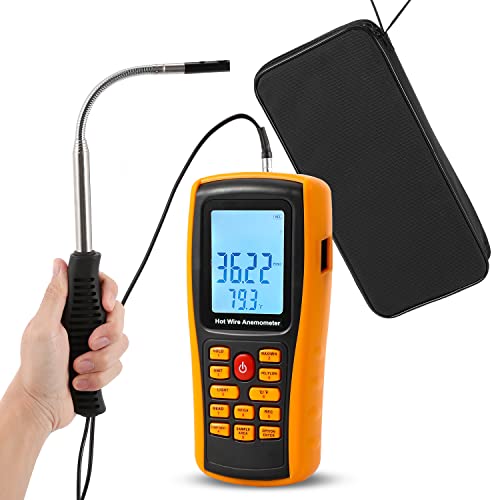
Bonvoisin’s Hotwire Anemometer focuses on practical HVAC readings with a 2-meter long probe and a 1.08-meter telescopic rod. It integrates wind speed in multiple units, air flow measurements in CFM or CMM, and temperature in Celsius or Fahrenheit. The device provides wind chill, maximum and minimum values, and average wind velocity. A backlight facilitates viewing in low-light conditions, and an auto-off feature conserves battery life. A protective case helps safeguard the instrument during maritime use and transport.
The long probe design is particularly useful for ductwork checks and boat ventilation assessments, where extended reach improves accuracy. It provides a balanced mix of handheld convenience and measure-ready versatility for sailors who perform on-board HVAC checks, maintenance, and airflow balancing tasks.
Vanlison Professional Hot Wire Anemometer

Vanlison’s 5-in-1 instrument covers wind speed, air flow volume (CFM/CMM), and temperature with a focus on HVAC use. It promises ±5% wind speed accuracy and ±1°C temperature accuracy, with a bright backlit display for easy reading. The meter calculates CFM/CMM directly by inputting duct cross-sectional area, which is valuable for on-boat ventilation tasks and environmental testing. The device aims to deliver precise measurements in a compact form factor suitable for sailors and technicians alike.
Its multi-parameter capability makes it useful for both onboard testing and workshop calibration. The backlit display and simple controls allow quick checks while navigating or performing routine checks after weather changes, helping boaters balance airflow and optimize comfort aboard.
Buying Guide
- Measurement needs: Choose a device that covers wind speed, wind temperature, and possibly wind chill if you sail in varied climates. For ventilation planning on a boat, consider CFM/CMM calculations and duct area inputs.
- Display and readability: A backlit screen is essential for dawn, dusk, or bright sun on the water. Some models offer color displays for quick condition checks.
- Data handling: If you need logs or remote access, prioritize Bluetooth or Wi‑Fi enabled units with data export (CSV/Excel) or cloud integration for cross-device analysis.
- Power and portability: Battery life and auto power-off features help ensure readings during longer trips. Tripod-mount options support hands-free operation when needed.
- Weather context: For boats, wind direction and speed are primary. Some stations provide additional weather data and forecasting integration, which can be valuable for route planning.
- Accuracy and range: Look for stated accuracy (often ±2–5%) and a wind speed range that matches your expected conditions on the water.
When selecting a wireless anemometer for boating use, assess how each device integrates into your existing gear, whether you need remote access to readings, and how you plan to log or share weather data with crew. A handheld model with a solid backlight and reliable wind speed readings works well for on-deck checks, while a Wi‑Fi or Bluetooth-enabled station can support longer-term weather monitoring and data analysis for sail optimization and safety planning.